Dentist Cavity Treatment: Know Your Options and What to Expect
November 7, 2026
Custom Fit Night Guards for Teeth Grinding: Protect Your Teeth
November 13, 2026
Last updated: November 9, 2026
Yes, Invisalign can correct some adult overbites when planned tooth movement can reduce a deep bite. Whether clear aligners will work for your bite depends on its severity, your tooth positions, and your jaw relationships. At Bajars & Bajars Dental, our teeth straightening and orthodontic treatment begins with an evaluation rather than a promise that one approach fits everyone.
Can Invisalign fix an overbite in adults?
Invisalign can correct some adult dental overbites, but clear aligners are not suitable for every deep bite. An overbite describes how far the upper front teeth overlap the lower front teeth vertically; a deep overbite means that overlap is excessive. The amount of overlap, the movements needed to change the bite, and any underlying jaw discrepancy determine whether aligners are a reasonable choice.
For an adult whose deep bite is mainly related to tooth position, a planned series of aligners may move teeth toward a better fit. A bite driven largely by the position of the jaws may call for a different approach. The question is not just whether the front teeth can look straighter, but whether treatment can produce an appropriate bite.
Does Invisalign work for every kind of overbite?
No. The Cleveland Clinic guidance on overbites explains that orthodontic treatment may be enough for some adults, while some severe cases require corrective jaw surgery in addition to braces. The position and condition of the teeth also matter, so an apparent deep bite cannot be judged reliably from a smile photo alone.
What did the 2026 Invisalign deep-bite study measure?
A 2026 Scientific Reports retrospective study measured lower-front-tooth movement and bite changes in adults with deep overbites treated with Invisalign and precision bite ramps. Researchers compared side-view head X-rays taken before and after treatment. Overbite decreased on average in this selected group; the study cannot predict any one patient’s result.
The 2026 Scientific Reports study included 27 adults ages 19 to 54 with overbites greater than 3 millimeters and skeletal Class I or II jaw relationships. Greater than 3 millimeters was this study’s enrollment cutoff, not a universal threshold for diagnosing a deep bite. Your dentist needs to assess your individual bite.
The study reported these measurements:
| Measure | Finding |
|---|---|
| Lower-front-tooth intrusion | The 2026 Scientific Reports study measured a mean of 1.63 mm. |
| Change in overbite | The 2026 Scientific Reports study measured a mean decrease of 1.98 mm. |
| Change in occlusal-plane angle | The 2026 Scientific Reports study measured a mean increase of 2.38°. |
The 2026 Scientific Reports study found no statistically significant changes in mandibular plane angle, lower-incisor angle or lower-molar extrusion. Although the occlusal-plane angle increased, that change does not demonstrate that aligners repositioned the patients’ jaws; the findings suggest limited vertical skeletal change.
Does measured tooth movement mean every overbite can be corrected?
No. The retrospective study examined selected adults who had already received a particular Invisalign treatment plan; it did not test every type or severity of overbite. An expert consensus on clear-aligner treatment strategies discusses clinical approaches to aligner treatment rather than testing outcomes for every kind of deep bite.
A case report of a Class II Division 2 deep-bite patient describes treatment involving clear aligners, a lower-premolar extraction, cantilever arms and elastics in a patient with multiple front crowns. A single patient’s outcome does not establish that similar cases are routinely suitable for aligners.
How can you tell a deep bite from an overjet or jaw problem?
A deep bite describes excessive vertical overlap between the upper and lower front teeth; overjet describes how far the upper front teeth project horizontally ahead of the lower teeth. A jaw discrepancy concerns the relationship between the jaws rather than tooth position alone. An exam and appropriate digital imaging help separate these problems before treatment is planned.
The Cleveland Clinic explanation of overbite versus overjet makes the vertical-versus-horizontal distinction. Some people have both, which is why calling any prominent upper teeth an “overbite” can obscure the treatment question. For a related comparison of bite patterns, see our guide to overbites and underbites.
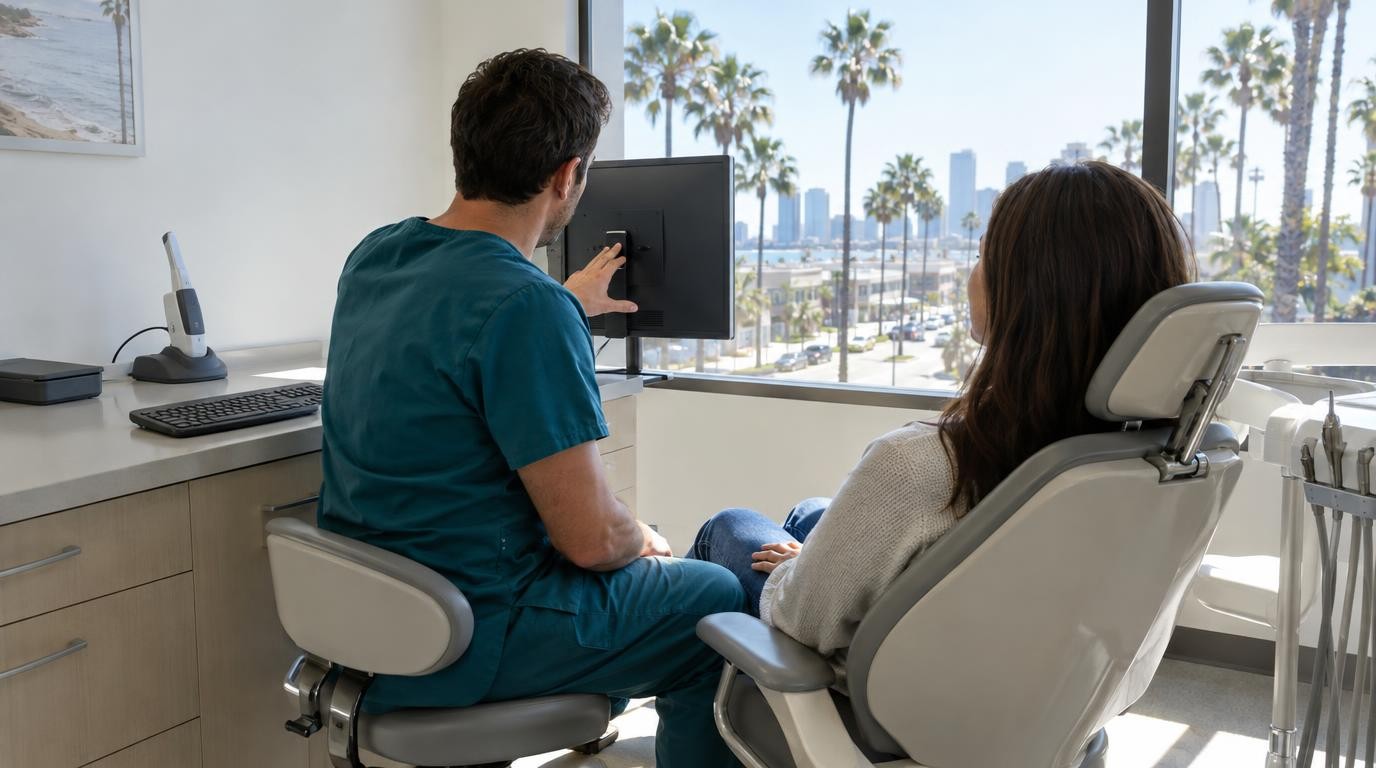
During a clinical bite assessment, the dentist looks at how the teeth meet as well as how they appear separately. Digital imaging adds information for planning tooth movement and assessing whether the bite concern may involve the jaws. Neither a mirror check nor an aligner simulation replaces that evaluation.
Who may be a good candidate for clear aligner overbite correction?
Adults may be good candidates when planned tooth movement can address their deep bite and the overall alignment problem is suitable for removable aligners. Teeth crowding or other misaligned teeth may also be considered in the plan. Candidacy depends on treatment difficulty, oral health, and whether the intended movements can produce a workable bite.
We select an appliance based on the movements your bite needs, not just how discreet it looks. The Cleveland Clinic guidance on braces and aligners notes that Invisalign generally treats mild to moderate orthodontic problems, while traditional braces may be more suitable for severe cases.
What cannot be fixed with Invisalign?
Clear aligners move teeth, but tooth movement alone cannot resolve a severe mismatch between the upper and lower jawbones.
How does overbite treatment with clear aligners work at Bajars & Bajars Dental?
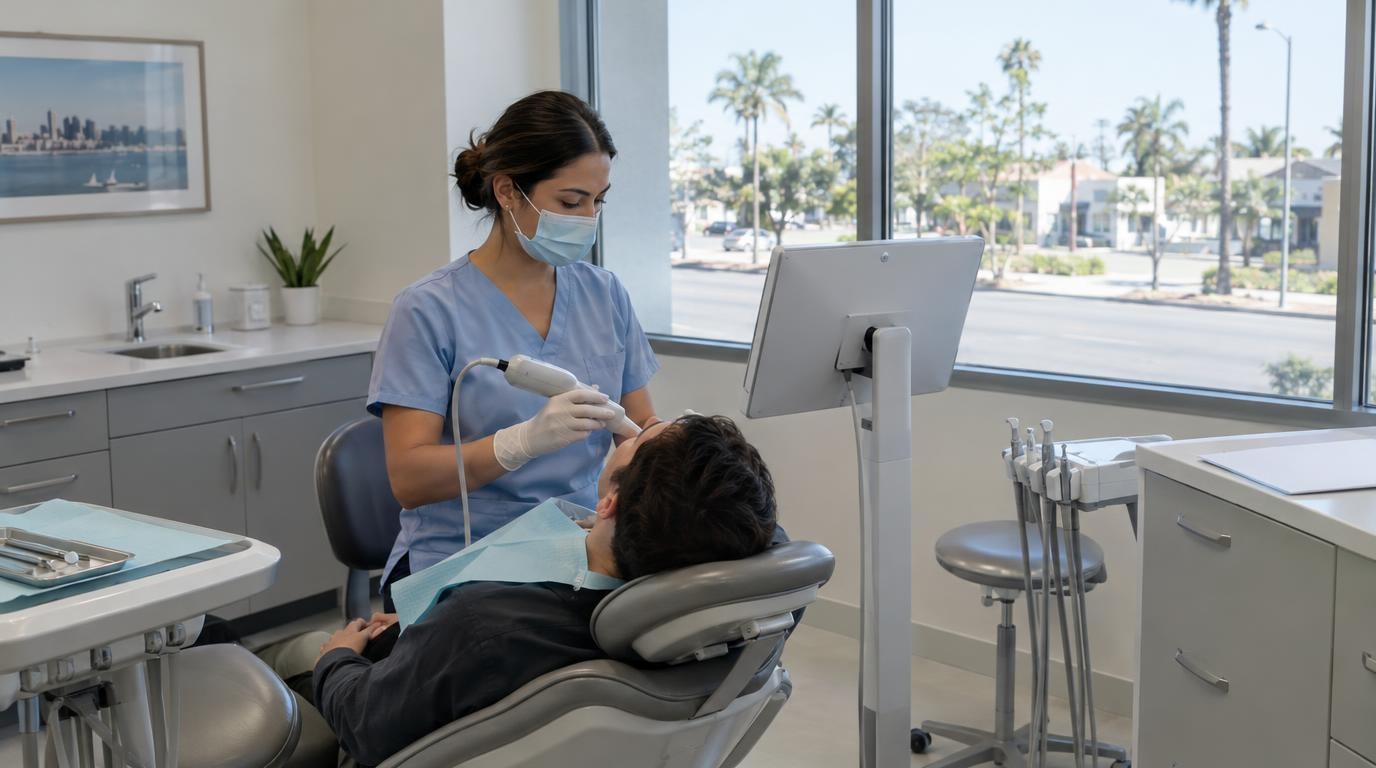
At Bajars & Bajars Dental in San Diego, we assess your teeth and bite, plan a series of removable aligners to move your teeth gradually when appropriate, and check your progress throughout treatment. The process includes:
- Consultation: We discuss the bite concern and what the patient hopes treatment will change.
- Evaluation and imaging: We assess tooth alignment, bite relationships, and overall oral health to inform the plan.
- Personalized treatment: When clear aligners fit the case, a series of custom removable trays gradually moves the teeth.
- Progress checks: We review movement and the developing bite throughout treatment.
Our clear-aligner options include Invisalign and ClearCorrect. For a more complex alignment or bite issue, we may recommend traditional or advanced orthodontic techniques instead.
Why does the dentist use an exam and digital imaging before recommending aligners?
The exam checks tooth positions, bite relationships and oral health, including dental or gum problems that may need attention before tooth movement. Digital imaging helps us plan the intended movements. A proposed final tooth arrangement is a planning tool, not a guarantee that every tooth or bite relationship will move exactly as depicted. Our guide to Invisalign attachments explains one feature that may be considered in an individual plan.
What does Invisalign treatment feel like, and how long does it take?
Clear aligners may cause temporary pressure or tooth soreness as a new tray begins moving teeth. The trays are removable, but they need to be worn and changed according to the individual treatment plan. Total treatment time depends on the movements required and the response observed at check-ins, so no single timeline fits every overbite.
The U.S. Food and Drug Administration’s clear-aligner guidance describes changing trays every one to two weeks and a possible overall treatment span of six to 18 months. Those are general figures, not a schedule or predicted finish date for a particular deep bite.
What results can adults expect after clear-aligner overbite treatment?
Adults can expect treatment to aim for a better-fitting bite as well as straighter-looking teeth, but the amount of overbite correction varies. Initial tooth and jaw anatomy, the movements planned, and treatment response all affect the result. A cosmetic improvement in the front teeth does not, by itself, show that the full bite goal was achieved.
If teeth do not move as projected, the developing bite may differ from the original plan. Our discussion of braces and clear aligners offers more context on how these approaches move teeth.
How is the corrected bite maintained after treatment?
After active treatment, retainers help prevent teeth from shifting back; Cleveland Clinic lists them as part of adult overbite care. Because teeth can shift throughout life, maintaining a corrected bite generally requires long-term retainer wear as directed. Without ongoing retention, the result may not last.
What are the risks and side effects of Invisalign for an overbite?
Clear-aligner treatment can cause temporary tooth tenderness or soft-tissue irritation, and a planned bite correction may be incomplete. Teeth may also shift after treatment if retention is not followed. The 2026 Scientific Reports study did not report rates for these effects, so it cannot tell you how often they occur with Invisalign deep-bite treatment. Before starting, oral health and bite complexity need review; discuss your own risks and treatment options with a licensed clinician.
Contact the treating dental team if pain persists, a tray repeatedly injures the mouth, or the gums bleed or appear infected. Cleveland Clinic guidance on braces and aligners advises contacting a dental professional for pain that does not resolve or for gum bleeding or infection. Seek urgent care for trouble breathing or swallowing or rapidly worsening facial swelling rather than waiting for an aligner check-in.
Who should wait before starting clear-aligner treatment?
Someone with an active dental or gum problem may need that problem evaluated and treated before orthodontic movement begins. A complex bite also warrants careful planning before choosing an appliance. Waiting in those circumstances allows the treatment recommendation to account for oral health, the intended tooth movements, and the possibility that another approach will fit better.
Is Invisalign or another treatment better for a complex overbite?
Another orthodontic approach may be better when a complex overbite requires movements that removable aligners cannot predictably provide. Traditional braces use fixed brackets and wires rather than removable trays and may be more suitable for severe cases.
Bite splints have a different role. We may use them in some cases to support alignment or protect teeth from grinding or excessive pressure, but a splint does not replace orthodontic correction of a deep bite.
What is the fastest way to fix an overbite?
There is no universal fastest treatment for an overbite. The appropriate plan depends on whether the problem is mainly dental or skeletal, how complex the required movements are, and how the bite responds. Choosing a seemingly quicker appliance that cannot meet the bite goal would not be a useful shortcut.
Frequently Asked Questions
How much overbite is normal for an adult?
A small vertical overlap is normal. Cleveland Clinic gives 2 to 4 millimeters as typical and describes a deep overbite as overlap of more than 30% of the lower front teeth (about 4 to 6 millimeters). How your teeth meet and whether the overlap causes problems also matter.
Do I need to treat an overbite if it does not hurt?
Not necessarily. Cleveland Clinic notes that an untreated deep overbite can contribute to tooth erosion, jaw pain or gum disease. Whether treatment is appropriate depends on the degree of overlap and whether your teeth, gums or bite function are affected.
Can I get Invisalign for a deep bite if I have crowns?
Possibly. Crowns do not automatically rule out clear-aligner treatment, but they can complicate planning. A published case report describes treatment of a complex deep bite in a patient with multiple front crowns using aligners alongside other techniques. That single case cannot predict whether aligners will work for your bite.
Will I need teeth removed to correct my overbite?
Not everyone needs extractions. Whether they are appropriate depends on the space available, tooth positions and the overall treatment plan. Cleveland Clinic lists extractions as an option to make room for the remaining teeth in adult overbite treatment.
What are precision bite ramps in Invisalign treatment for a deep bite?
Precision bite ramps are raised areas inside some upper aligners that provide contact points for the lower front teeth when you close your bite. A Scientific Reports study observed lower-front-tooth intrusion in adults treated with Invisalign and these ramps. It did not establish that every deep bite needs ramps or that ramps alone produced the improvement.
Can I eat while wearing Invisalign for an overbite?
Remove your aligners before eating, then clean your teeth before putting them back in. Aligners are removable, but they must be worn according to your individual plan for tooth movement to progress. At Bajars Dental, we review wear instructions during treatment and address fit concerns at regular check-ins.
How should I clean my Invisalign trays during overbite treatment?
Rinse your aligners and clean them gently as directed by your dental team. Avoid hot water, which can distort the trays, and brush and floss your teeth before replacing them to avoid trapping food. At Bajars Dental, we can give you cleaning instructions suited to your aligners and treatment plan.
How can Chula Vista patients find out which overbite treatment fits?
For patients coming from Chula Vista, we assess the teeth, bite and oral health at Bajars & Bajars Dental in San Diego. An examination and digital imaging help us determine whether Invisalign, ClearCorrect or another orthodontic approach fits the bite concern.
If you are considering adult overbite correction, contact Bajars & Bajars Dental to schedule a consultation. Our team can assess your teeth and bite, explain the options that fit your findings, and help you understand what a realistic treatment plan would involve.
This information is general and is not medical advice. Talk to a licensed clinician about your own situation before making a treatment decision.