Custom Fit Night Guards for Teeth Grinding: Protect Your Teeth
November 13, 2026
Sensitive Teeth Dentist: When to Visit and What Helps
November 20, 2026
Last updated: November 15, 2026
Yes, dental implants can replace missing front teeth when an examination shows that the bone, gums, and overall health support treatment. For a tooth that shows when you smile, the most useful starting point is the future crown: where the visible tooth needs to sit should guide the position of the implant beneath it.
Can dental implants replace a missing front tooth?
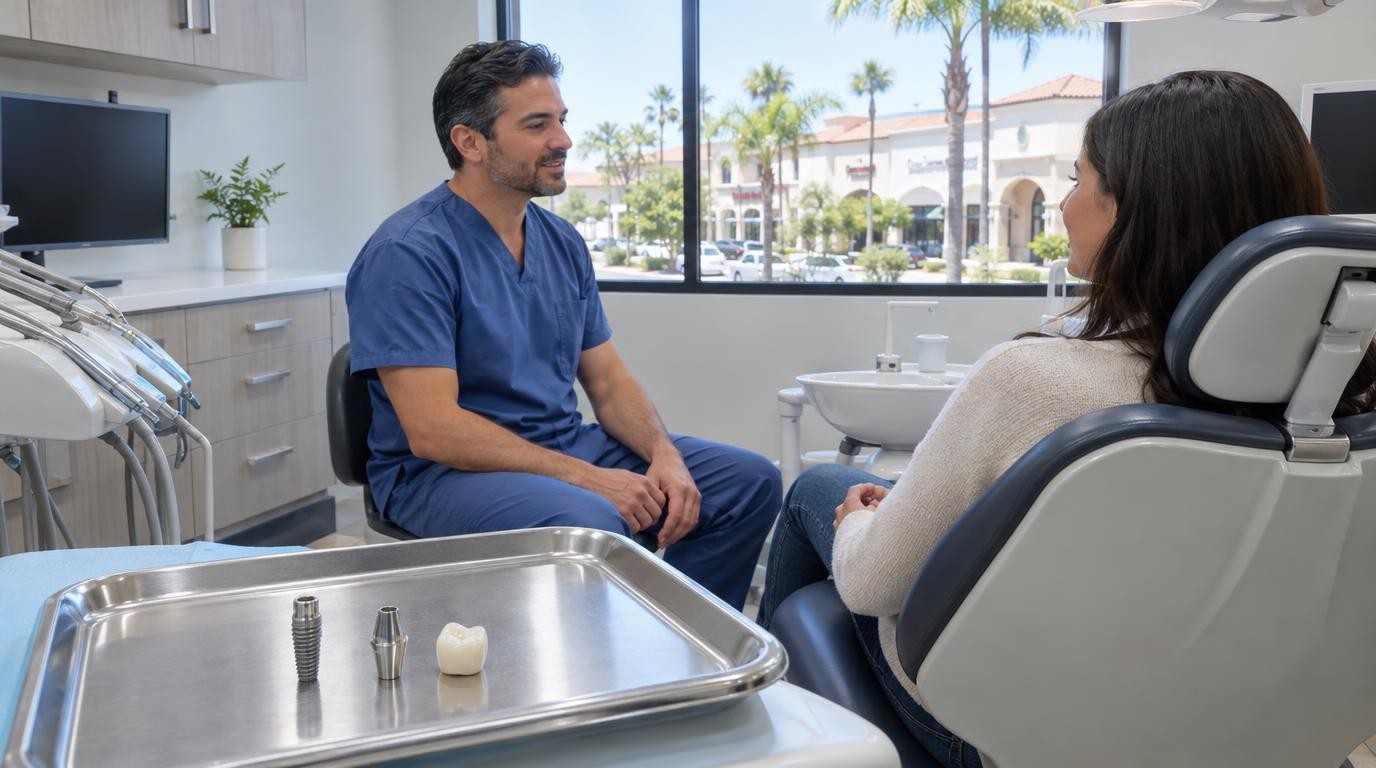
A titanium post takes the place of the tooth root, an abutment connects the post to a crown, and the crown fills the visible gap.
If several front teeth are missing, separate implants may support individual crowns. For three or more missing teeth, two or more implants may instead support a bridge. We assess the bone, gums, and planned replacement teeth to determine which approach may fit.
What are the parts of a front-tooth dental implant?
As bone heals around the post, it stabilizes the implant that supports the abutment and tooth-colored crown. At Bajars Dental in San Diego, our dental implant treatment uses this post, abutment, and crown approach.
How does an implant differ from a bridge for a single missing tooth?
A conventional bridge fills the gap with an artificial tooth supported by prepared neighboring teeth. An implant supports its own crown without that preparation. Cleveland Clinic identifies preservation of neighboring tooth structure as an advantage of an implant, but the condition of those teeth and the implant site still matter when choosing a front tooth replacement.
An implant may help preserve jawbone at the missing-tooth site, though it cannot prevent all bone loss. Replacing a front-tooth gap may also help you speak more easily and keep neighboring teeth from shifting. Those possible benefits are not guaranteed, and limiting tooth movement is not exclusive to implants.
Why should the crown position guide front-tooth implant placement?
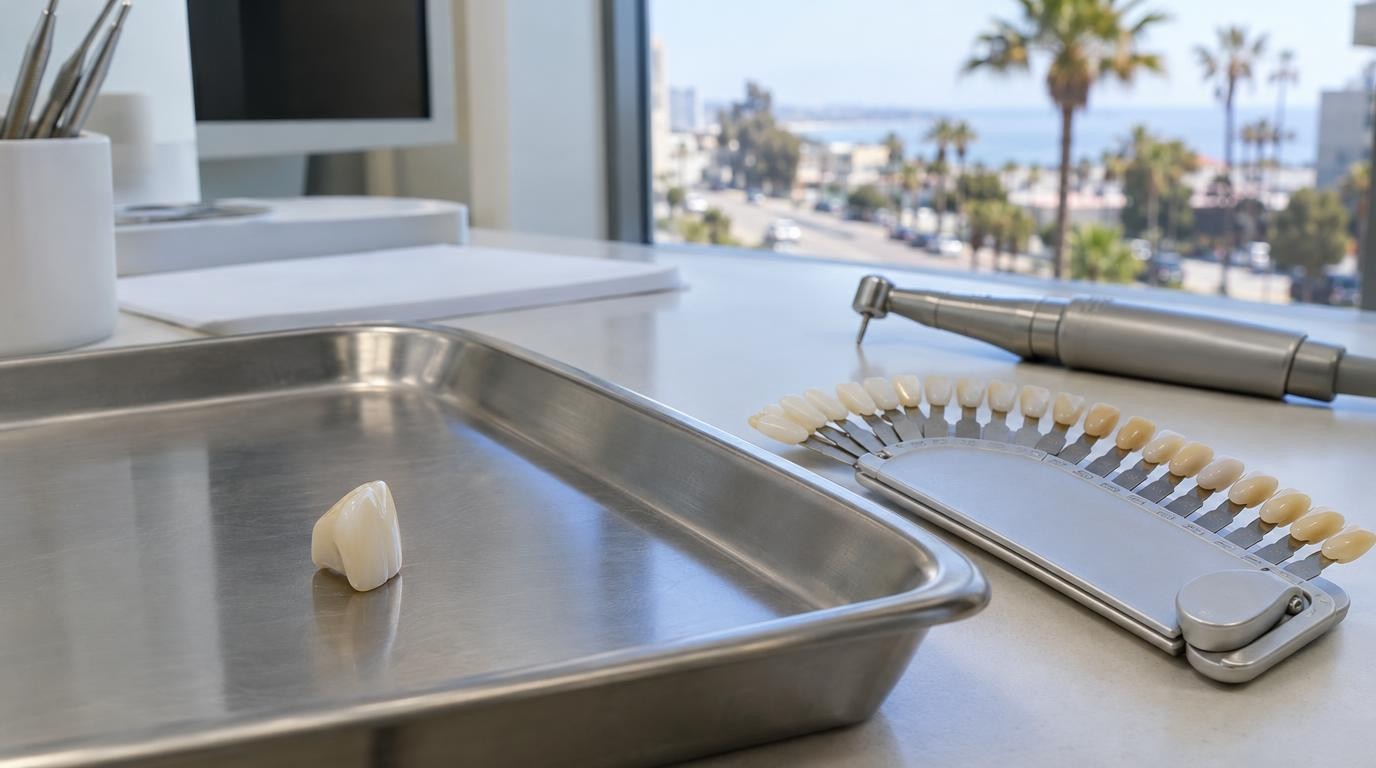
The planned crown position should guide the implant’s position and angle because the crown and surrounding gums determine much of the visible result. In the upper front-tooth region, appearance is a central planning concern. A crown-first plan checks whether the available bone can support an implant in a position that also supports the intended tooth.
What should a three-dimensional front-tooth implant plan check?
A clinical guide and literature review in the Journal of Maxillofacial and Oral Surgery explains that the final crown position should dictate implant placement within the bone. The review calls for clinical, radiographic, and diagnostic evaluation of bone quantity and quality, gum characteristics, anatomical constraints, and the adjacent and opposing teeth. It also distinguishes the appearance priorities of upper front teeth from the loading priorities of back teeth.
A position that fits within the bone may not, by itself, support the intended visible crown or gumline.
When might a front-tooth implant need bone grafting?
A bone graft may be considered when the available bone cannot adequately support the planned implant position. The examination helps determine whether grafting is indicated and whether it belongs before or during implant placement; neither sequence is appropriate for every patient. For more detail on why support matters, see this educational explanation of bone grafting for dental implants.
Who is a good candidate for a front-tooth implant?
A good candidate generally has healthy gums, adequate jawbone to support an implant, and an overall health history compatible with healing. Every prospective implant patient needs a pre-treatment examination and an individual plan.
Can you get a front-tooth implant if you have bone loss?
Possibly. The American Academy of Periodontology identifies adequate bone and healthy gum tissue as important candidate factors. When bone support is limited, an examination can establish whether grafting could help or whether another replacement would be more suitable. Our guide to dental implants with bone grafts explains how that additional step can affect the plan.
What if you smoke or have a chronic health condition?
Heavy smoking, chronic conditions, and prior radiation to the jaw warrant a closer, individualized evaluation before implant treatment. Active gum disease should be evaluated and treated before implant placement because an implant depends on healthy surrounding tissue as well as underlying bone. An examination is necessary even when a person feels otherwise healthy.
What happens during front-tooth implant treatment and recovery?
How long does a front-tooth implant take?
At Bajars Dental, the full process can take several months and requires multiple visits. The steps in our sequence are:
- Examination and planning: Check the implant site and the intended crown position.
- Bone grafting, if indicated: Improve support where the assessment shows it is needed.
- Implant placement and bone healing: Place the post and allow the jawbone several months to integrate with it.
- Abutment and gum healing: Connect the abutment; in our described sequence, gum healing can take up to three weeks.
- Crown placement: Attach the visible replacement tooth once the site is ready.
Initial healing after implant surgery often takes about one week, separate from the months needed for bone integration. Both timelines vary by person, and grafting, when needed, can change the schedule. Your clinician may recommend pain medicine or antibiotics if needed; stitches, if used, may dissolve or need removal at a follow-up visit.
Will I have a temporary tooth while the implant heals?
A temporary tooth can cover a visible front-tooth gap while the implant heals. A removable partial temporary denture is one option; whether a temporary replacement is suitable depends on the healing site.
How successful are front teeth implants, and what are the risks?
Our general estimate is that approximately 98 percent of dental implant procedures succeed. A 2014 study in The Journal of the American Dental Association reported 97 percent success and 97 percent survival for single-unit implants at four to six years of follow-up. Neither figure is specific to front teeth or predicts your individual outcome. Bone support and healing affect implant success, while the crown and gumline also affect the visible result.
What could affect healing or the appearance of a front-tooth implant?
Inadequate bone support or failure of the bone to join firmly to the implant can prevent the intended result. Surgery also carries risks of infection at the implant site and injury to nearby structures, such as teeth, blood vessels, or nerves. Mayo Clinic notes that soreness and swelling can occur after surgery and that smoking may contribute to implant failure or complications. At a front tooth, a difference in gum contour, crown shape, or crown color may also be noticeable even when the implant is stable.
Contact the treating team if swelling, soreness, or another problem worsens in the days after surgery, as Mayo Clinic advises. Trouble breathing or swallowing needs urgent medical care. Discuss your own risks and recovery instructions with your clinician before treatment.
When might an implant not be the right choice?
An implant may not be suitable if the site cannot provide dependable support or if health and healing concerns make the procedure inappropriate. Bone loss does not automatically rule one out, but neither grafting nor implant integration can be promised. A bridge or removable replacement may be a better fit after the bone, gums, neighboring teeth, and health history are assessed.
What will a front-tooth implant look and feel like?
A front-tooth implant crown is designed to look natural beside nearby teeth and to provide a stable replacement after healing. Its shape, position, color, and surrounding gumline all influence the appearance. A close match is the goal, not a guarantee, and an implant should not be expected to feel identical to a natural tooth.
How is an implant crown matched to nearby front teeth?
Matching involves more than choosing a shade. The crown’s width, outline, position, and color need to work with the neighboring teeth, while the gums frame the visible result. In clinical practice, a crown that looks convincing on its own must also look appropriate within the whole smile. Our explanation of how dentists make front-tooth crowns look natural explores those details.
How do you care for a front-tooth implant?
Brush and floss your implant regularly, and keep up with recommended dental examinations and cleanings. With proper care, the implant post can often last a lifetime, while the crown generally has a shorter lifespan and may need replacement. Neither lifespan is guaranteed.
What can I do for missing front teeth if an implant is not right for me?
A conventional dental bridge or a removable denture can replace a missing front tooth when an implant is unsuitable or not preferred. A bridge relies on neighboring teeth, while a removable option rests in the mouth without an implanted post. The best choice depends on the bone and gums, adjacent teeth, desired appearance, and personal preference.
How does a bridge compare with an implant for a missing front tooth?
An article on Cleveland Clinic’s site reports that most patients find bridges and implants relatively similar for basic day-to-day chewing, although the replacements rely on different kinds of support.
The main practical differences are:
| Option | Support | Consideration for a front tooth |
|---|---|---|
| Single-tooth implant | A post in the jawbone | Avoids preparing neighboring teeth but requires a suitable implant site and healing period |
| Conventional bridge | Prepared neighboring teeth | Does not require an implant post but involves the teeth beside the gap |
The health of the neighboring teeth can make that difference especially relevant. Our fixed bridge versus dental implant guide offers a closer look at the tradeoffs.
When might a removable denture be considered?
A removable denture may be considered when a person does not want an implant or when the implant site or neighboring teeth make other approaches less suitable. Because a removable replacement sits and functions differently from a fixed implant crown or bridge, ask how it would look, stay in place, and be cleaned. There is no universal best choice for every missing front tooth.
What should I ask at a San Diego front-tooth implant consultation?
Ask how the future crown will guide implant placement, what the examination shows about bone and gums, and whether grafting is indicated. A useful treatment plan should also explain the sequence of visits, expected healing stages, and options for the visible gap while healing. These answers help you compare an implant with other replacements.
Will you plan the implant from the future crown position?
Ask to review the proposed crown position and implant angle. You can also ask how the planned position relates to adjacent teeth, the opposing bite, and the available bone. The answer should connect the surgical position to the tooth you will see, rather than treating crown placement as a separate decision made afterward.
What should my treatment plan say about bone, gums, and healing?
Ask what the examination shows about bone volume and quality, gum thickness, and the health of nearby teeth. If grafting is proposed, ask why it is needed and when it would occur. The plan should distinguish expected healing stages from promises about timing, explain any interim appearance options, and identify the factors that could change the sequence.
Frequently Asked Questions
Can you get implants if you have no teeth?
Yes. Several implants can support replacement teeth for an entire arch, even if no natural teeth remain. The American Academy of Periodontology explains that full-mouth implants replace teeth and some of their roots. Options include fixed full-arch replacements and removable implant-supported dentures, as described in Cleveland Clinic’s guide to implant-supported dentures. Whether either option suits you depends on your jawbone, gums, and overall health; bone grafting may be needed if support is limited.
Can a front-tooth implant be placed on the day the tooth is removed?
Sometimes. An implant can be placed immediately after extraction in a suitable site, but other sites need time to heal first. The site’s bone and gum condition, anatomy, and intended crown position help determine whether immediate placement is appropriate. Placing the implant immediately after extraction and attaching the final crown immediately are separate decisions.
Do I remove a temporary partial denture to clean it?
Yes. If your temporary replacement is a removable partial denture, you can take it out for cleaning and while you sleep. Ask your clinician how to clean it without disturbing the healing site.
How long does it take for a front-tooth implant to fuse with the jawbone?
Jawbone fusion can take three to nine months, according to Cleveland Clinic. This process, called osseointegration, gives the implant stability before the final tooth is attached. Healing varies by person and treatment plan, so that range is not a promised date for your final crown.
What can I eat after front-tooth implant surgery?
Soft foods may be needed after each stage of implant surgery while the surgical site heals, as Mayo Clinic notes. When you can return to your usual diet depends on healing and whether your treatment includes additional procedures.
How long does the crown on a front-tooth implant last?
An article on Cleveland Clinic’s site reports that crowns on implants generally last around 15 years. That estimate applies to the crown, not the implant post beneath it, and is not a guarantee. A crown may need replacement even if the implant remains stable. Brushing, flossing, and dental visits help us monitor both.
Can a front-tooth implant get a cavity?
No. The implant and its crown cannot develop a cavity like a natural tooth. An article on Cleveland Clinic’s site notes that implants do not get cavities but still need care and maintenance. Brush and floss around the implant and attend regular dental visits to care for the surrounding gums and neighboring natural teeth.
Is a crown-first plan right for your missing front tooth?
A crown-first plan is a useful starting point for evaluating a missing front tooth because the visible replacement and the implant beneath it must work together. Whether an implant is right for you still depends on an examination of your bone, gums, neighboring teeth, and health. A bridge or removable replacement may also deserve consideration.
To discuss your options, contact Bajars Dental in San Diego for a consultation. Ask us how the crown and implant positions would be planned for your site and what treatment sequence may be appropriate.
This information is general and is not medical advice. Talk to a licensed clinician about your own situation before making a treatment decision.